Why the magnesium with the biggest number on the label delivers the least
Pick up two magnesium bottles. One says 500 mg, one says 200 mg. Most people buy the 500. In a lot of cases they have just bought the weaker product.
Here is the part the front of the bottle never explains. "Magnesium" on a shelf is never pure magnesium. It is magnesium bound to something else, and that something else changes two separate things: how much of the capsule is magnesium at all, and how much of that magnesium actually gets into you.
Those two numbers frequently disagree. That is the whole story.
The oxide paradox
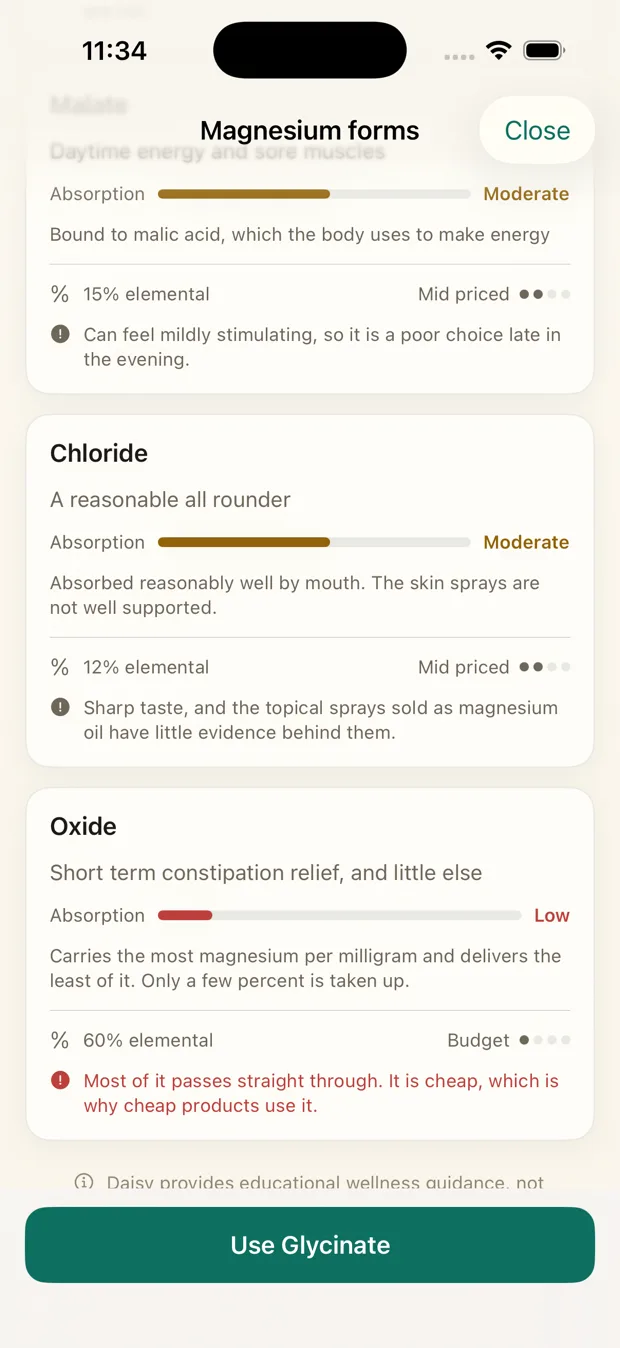
Magnesium oxide is around 60% magnesium by weight. That is the highest of any common form. It is also the cheapest to make, which is why it dominates budget multivitamins and why the bottles that shout the biggest numbers are so often oxide.
And your body absorbs only a small percentage of it. Most of it passes straight through. Oxide's main practical use is as a short-term laxative, which is a real use, and not the one on the front of the box.
Magnesium glycinate is about 14% magnesium by weight. A quarter of oxide's figure. Most of it arrives.
The label with the biggest number is usually the one delivering the least. Neither number is a lie. Shown one without the other, you draw exactly the wrong conclusion.
There is no best form, and anyone selling you one is selling you something
This is where most "best magnesium" articles go wrong. They rank the forms one to seven and put glycinate at the top. But magnesium citrate draws water into the bowel and loosens stools. If you are constipated, that is precisely why you buy it. If you are not, it is precisely why you avoid it.
Same molecule. Opposite verdict. The variable is not the supplement, it is you.
The seven forms, plainly
| Form | Best for | Absorption | The honest downside |
|---|---|---|---|
| Glycinate | Sleep, anxiety, a sensitive stomach | High | Bulky. More capsules for the same dose, and pricier than citrate. |
| L-Threonate | Memory and focus | High | Several times the price, and only 8% of the capsule is magnesium. |
| Malate | Daytime energy, sore muscles | Moderate | Can feel mildly stimulating. A poor choice late in the evening. |
| Taurate | Blood pressure, heart rhythm | High | Thinnest evidence base of the well absorbed forms, and hard to find. |
| Citrate | Constipation, best price per dose | Moderate | Loosens stools. The point if you want it, a problem if you do not. |
| Chloride | A reasonable all rounder | Moderate | Sharp taste. The topical "magnesium oil" sprays have little behind them. |
| Oxide | Short term constipation relief | Low | Most of it passes straight through. Cheap, which is why cheap products use it. |
How to read a magnesium label in ten seconds
- Find the form. It is usually in small print on the back, not the front. If the label only says "magnesium" with no form named, assume oxide.
- Read the Supplement Facts panel, not the front. The panel declares elemental magnesium, the amount that is actually the mineral. The front of the bottle often quotes the weight of the whole compound, which is a much bigger and much less useful number.
- Match the form to why you are buying it. Sleep, glycinate. Focus, threonate if you can afford it. Constipation, citrate. Nothing in particular, citrate or glycinate.
- Check the total, not the bottle. If you also take a multivitamin or a greens powder, you are probably already getting magnesium from them.
How much is too much
The tolerable upper intake level for supplemental magnesium is 350 mg per day from supplements, set by the US Institute of Medicine. That figure applies to supplements only, not to magnesium from food, which is not capped in the same way because your kidneys handle dietary magnesium comfortably.
Going over it usually means diarrhoea rather than anything dangerous, for a healthy adult. It matters much more if you have reduced kidney function, in which case magnesium can accumulate. Talk to your doctor before supplementing magnesium if that applies to you.
The version of this that lives in the app
Daisy does this comparison for you and, more usefully, filters it by what you told it about yourself. If you said you want better sleep, glycinate is the one it puts in front of you, and it says why. If you scan a bottle of oxide in a shop, it tells you what is in your hand and what would suit you better.
Sources
- Magnesium fact sheet for health professionals, NIH Office of Dietary Supplements. Reference intakes, the 350 mg supplemental upper limit, and the note that oxide is among the least well absorbed forms.